Collection Pages vs Blog Posts: Which Drives Sales?
Collection pages drive more sales than blog posts because they catch shoppers who already know what they want, while a blog post catches someone still asking questions. Blog posts win on volume and AI citations, and a good one feeds the collections below it. Build the collections first and aim every post at one.
Key Points
| Factor | Collection Pages | Blog Posts |
|---|---|---|
| Who lands there | Shoppers ready to buy | Shoppers still researching |
| Typical conversion | 2 to 5% of visitors | Under 1% of visitors |
| Searches per keyword | Fewer, higher value | More, lower value |
| Time to rank | Weeks on a store with sales history | Weeks to a year, then it compounds |
| AI search role | The page ChatGPT sends buyers to | The page AI answers quote |
| Build order | First | Second, aimed at the collections |
What Collection Pages Do
Collection pages do the selling on a Shopify store because they are the pages that rank for the words a buyer types right before checkout, like “women’s hiking boots” or “split king adjustable bed.” Shopify treats them as your category pages: a product grid, a title, and a description area, built by hand or filled by rules you set in Shopify’s collections setup. A shopper on one of these pages is one click from a product and two clicks from a cart.
That closeness to the cart is why they convert the way they do. On the Shopify stores I run, commercial pages land in the 2 to 5% range while informational posts sit under 1%. Same store, same products, five times the conversion, because of what the visitor typed.
Google reads them the same way. Its ecommerce site structure guidance says the more links a page has within a site, the higher its relative importance, and collection pages sit in the menu, the footer, and every product breadcrumb. Your collection pages are the most linked pages on your store, so they carry the most authority you have. The collection page SEO fixes that move rankings are mostly about putting that authority to work: a title tag that says what the page is, 300 to 500 words of buying help at the bottom, and clean links down to every product.
What Blog Posts Do
Blog posts bring in the shoppers your collection pages cannot reach because they rank for the questions people ask weeks before they buy, like “how to choose a yoga mat” or “best heated jacket for women.” A post pulls traffic on searches no product page could rank for, then hands that reader to a product. Shopify builds a blog into every store for exactly that handoff.
Most of that traffic is informational, and that is where the numbers turn. Semrush’s study of 200,000 AI Overview keywords found about 80% of the searches that trigger an Overview are informational and under 3% are transactional, so the blog is the part of your store that now competes with Google’s own answer. A post can rank first and still watch a chunk of its clicks stay on the results page.
Still, the right post pays for years. HubSpot’s look at its own compounding blog posts found about one post in ten keeps growing after it publishes, and those posts bring in 38% of all blog traffic, so one compounding post does the work of six regular ones. The posts that compound for stores are the ones written for buyers: “best [product] for [use case]” and the pre-purchase questions your support inbox already gets. That is the whole idea behind bottom of funnel content, and it is the only kind of blogging I recommend a store start with.
One more thing a post does that a collection page cannot is capture the shopper who is not buying today. An email signup on a “how to choose” post turns a reader you cannot rank for twice into someone you can email when the sale starts. That list is the part of blog traffic that never shows up in a sessions graph and still pays.
Which Drives More Sales?
Collection pages drive more sales than blog posts on every store I have measured, because the visitor arrives with buying intent and the page is built to convert it. A blog post has to earn a second click before it can earn a sale, and most readers never take it. For a store that needs revenue this quarter, the collections are where the effort goes.
The clearest example I have of that is Exclusive Beauty Club. I rebuilt 50 branded collection pages, new title tags, rewritten content, FAQs, and a “Dermatologist-Recommended” title modifier, and clicks to those pages grew 540% year over year, as laid out in the Exclusive Beauty Club case study. Those pages got the treatment before the blog did, on purpose, because they are the pages that turn a click into an order.
But the blog on the same store shows what a post can do when it is aimed right. The sunscreen cluster went from 207 clicks to over 6,000 in a year, the acne sunscreen post ranks first above Ulta and Sephora’s shopping ads, and every one of those posts links into a sunscreen collection. A blog post drives sales when it sits one click from a collection page and never when it stands alone.
So collections win on conversion rate and revenue per visit, and blog posts win on reach and on how many new buyers they introduce to the store. The store that wins overall runs both, in that order.
Which Wins in AI Search?
Blog posts win in AI search because ChatGPT and Google’s AI Overviews quote pages that answer a question, and a collection page does not answer anything, it lists products. Surfer’s analysis of 5 million AI citations found domain authority barely predicts who gets cited, with correlations close enough to zero to be noise, so a small store’s post can be the source as easily as a publisher’s.
That is what happened with Fieldsheer. The post “The 9 Best Heated Jackets for Women” hit #1 on Google two weeks after it published, landed in the AI Overview in the same window, and by spring ChatGPT named the Fieldsheer Ventani its top pick with that post as a source. Total sales grew 104% year over year, per the Fieldsheer case study. No collection page could have done that, because no collection page answers “which one should I buy.”
Even so, the collection page still closes the sale that the post opens. Shopify’s Q1 2026 AI search data shows AI-referred sessions convert about 50% higher than organic search, and more than half of them land on product pages instead of the homepage. The model reads your post, then sends the buyer to the product or collection it points at. So the post earns the citation and the collection page earns the order, and they need each other to do either.
Just know that chasing citations by rewriting your collections into articles backfires. A collection page stuffed with 1,200 words of “what to look for” pushes the products off the screen and converts worse, while still losing the citation to a real post. Leave the collection page as the place to buy and give the model a post to quote.
Two Questions Store Owners Ask Me
Can a Blog Post Outrank My Own Collection Page?
Yes, a blog post can outrank your own collection page when both target the same buying keyword, because Google picks one page per site for most searches and it picks the one that fits the query better. A 1,500-word post about “linen sheets” has more text for Google to match than a collection page with a grid and two sentences, so the post wins, and then it converts at a fifth of the rate the collection would have.
The fix is to keep the two aimed at different searches. The collection owns “linen sheets.” The post owns “linen vs cotton sheets” or “how to wash linen sheets,” and it links to the collection in its first half. When a post and a collection are already fighting over one keyword, the usual cure is to move the post’s target, not delete it, which is the same call I walk through in how to fix keyword cannibalization.
Should I Put a Blog-Length Description on a Collection Page?
No, a collection page should not carry a blog-length description, because the products are the content and anything that pushes the grid below the fold costs you clicks. A short line or two at the top and 300 to 500 words of buying help at the bottom is plenty. The bottom section covers materials, sizing, and the one or two questions shoppers ask before they add to cart.
Anything longer than that belongs in a post the collection links to. That keeps the collection page fast to scan for the buyer and gives Google a second page to rank for the longer question, which is two pages working instead of one page trying to be both.
Link the Two Into One Cluster
Linking collection pages and blog posts into one cluster is what makes either page type pay, because Google finds your best content by analyzing the relationship between pages based on their links, and a post that nothing links to sits as a near-orphan. Every post links to the collection it supports. Every collection links back to the posts that answer the pre-purchase questions. Both directions, on purpose.
From there, the order I run it in is the same on every store:
- Build the collection pages for the words buyers type, with a title tag that says what the page is and a short buying guide at the bottom.
- Write one post per real shopper question in that category, and put a link to the matching collection in the first half of the post, not the last paragraph.
- Link the collection back to its two or three best posts, so the authority you built in the menu flows into the content.
- Add the post to the blog’s related-posts block and to the menu if it is a “best of” guide shoppers will want.
Once those links are in, the two page types stop competing and start covering the same buyer at two moments. On Ergomotion, the “adjustable beds for acid reflux” collection and the “5 Best Adjustable Beds for Acid Reflux” post overlap, and I don’t care. Most SEOs will argue with me on that. The overlap is small, and it gives the store two chances at the same search, with Google picking whichever page fits better. That is the same reason a topic cluster beats a keyword list for a store: the cluster is the collection plus its posts, not one or the other.
Build Collections First, Then Blog
You should build collection pages first and add blog posts second for most stores, because the collections convert today and the posts take months to compound. Ahrefs’ ranking timeline study found only 1.74% of new pages reach the top 10 within a year and the average #1 page is about five years old, so a blog started this month is a bet on next year. A collection page on a store with sales history moves faster, because Google already trusts the domain and the page is already linked from the menu.
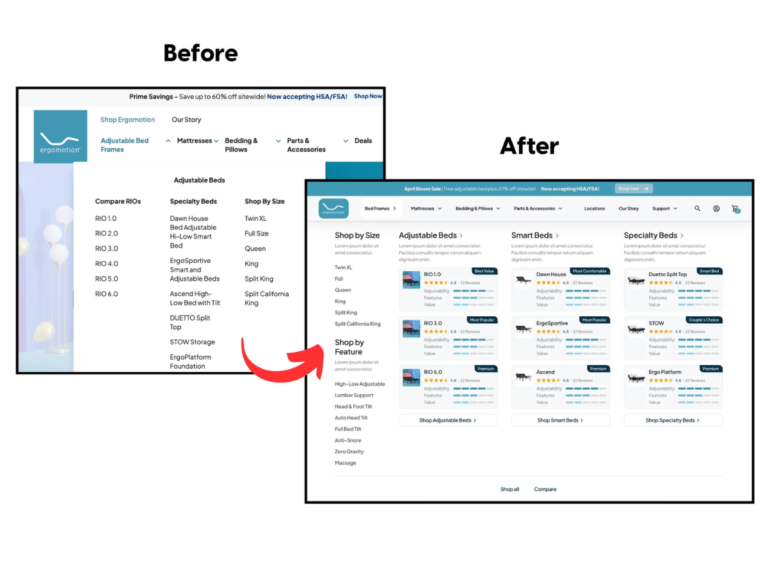
That is why the order matters more than the effort. On Ergomotion, the site was organized by model name, RIO 1.0 through 6.0, and nobody searches for a model number. I rebuilt the collections around how people shop, by size, by feature, and by condition, and rewrote the Ascend’s title tag to “High-Low Adjustable Bed with Tilt.” That one page now sits at #2 for “hi low adjustable bed,” above medical suppliers, and total sales rose 103% in peak season. The blog got its turn after the collections had already proven themselves in the sales numbers.
Pick collection pages first if:
- You have three or more products that fit a category shoppers search for by name.
- Your store already gets traffic and the collections are thin or unoptimized.
- You need revenue in the next 60 to 90 days.
Pick blog posts first if:
- Your collections are already ranking and converting, and the next gain is new shoppers.
- Your product needs explaining before anyone buys it.
- You sell in a category where “best [product] for [use case]” searches outnumber the category search.
Whichever side you start on, the second one comes next, not never. A store with strong collections and no blog runs out of new buyers. A store with a big blog and weak collections has readers with nowhere to buy. Get your top five to ten collections ranking, then write the posts that feed them, and keep both linked. That order is the spine of every plan I build inside my Shopify SEO services, and it is the order the case studies above ran in.
Want to Know Which Pages Are Costing You Sales?
Collection pages drive the sales and blog posts drive the shoppers, and the stores that grow build the first before the second and link the two the whole way. If your blog gets traffic but your revenue is flat, the collections are the gap. If your collections rank but growth has stalled, the blog is the next lever.
If you want to see which one your store needs first, book a call and I’ll pull your Search Console, split your clicks between collections and posts, and show you where the next order is hiding. And if you would rather have the whole map built and run for you, that is what my Shopify SEO services cover.
Sources:
- Shopify Help Center: Collections – https://help.shopify.com/en/manual/products/collections
- Google Search Central: Help Google understand your ecommerce site structure – https://developers.google.com/search/docs/specialty/ecommerce/help-google-understand-your-ecommerce-site-structure
- Semrush: AI Overviews study – https://www.semrush.com/blog/ai-overviews-study/
- HubSpot: Compounding blog posts – https://blog.hubspot.com/marketing/hubspot-blog-compounding-posts
- Surfer: Domain authority and AI citations – https://surferseo.com/blog/domain-authority-impact-on-ai-citations/
- Shopify: AI search insights, Q1 2026 – https://www.shopify.com/enterprise/blog/ai-search-insights
- Ahrefs: How long does it take to rank? – https://ahrefs.com/blog/how-long-does-it-take-to-rank/