
7 Steps to Rank on ChatGPT (With Revenue Proof)
You rank on ChatGPT by getting cited, not by ranking pages. ChatGPT names the brands it finds in sources it trusts, so you need three things: pages its crawler can reach, answers it can lift in a couple of sentences, and mentions on the lists it pulls recommendations from. The 7 steps below cover all three.
Step 6 is where the revenue proof lives, so read to the end.
Key Points
- ChatGPT recommends brands by name, so ranking means getting cited, not winning a blue link.
- If OAI-SearchBot is blocked in your robots.txt, you can vanish from ChatGPT search answers.
- “Best of” lists were 43.8% of the page types ChatGPT cited for top-of-funnel prompts in one 26,283-URL study.
- AI referrals to US retail sites converted 42% better than other traffic in March 2026, per Adobe.
- Fresh pages win citations: 79% of the lists ChatGPT cited had been updated within the past year.
1. Let OAI-SearchBot Into Your Site
The first step to rank on ChatGPT is letting OAI-SearchBot into your site. OpenAI says your pages become eligible for ChatGPT search answers when its search crawler is allowed in robots.txt, and sites that block it can drop out of answers entirely. This check takes ten minutes and decides everything after it.
Open yourdomain.com/robots.txt and look for OAI-SearchBot. OpenAI runs separate bots for separate jobs, and OpenAI’s ChatGPT search documentation is clear that each permission is independent. GPTBot handles model training, ChatGPT-User handles live page visits, and OAI-SearchBot handles search.
That means you can block AI training and still show up in ChatGPT answers. Plenty of store owners blocked every AI bot in 2024 out of caution and are still paying for it today. Blocking OAI-SearchBot is opting out of ChatGPT customers.
2. Get Indexed Beyond Google
Ranking on ChatGPT means getting indexed beyond Google, because ChatGPT does not search the web alone. OpenAI says it partners with third-party search providers and sends them rewritten queries, so the indexes those providers hold decide which of your pages can even enter the answer.
The practical move is Bing. Verify your domain in Bing Webmaster Tools, submit your sitemap, and inspect your top revenue pages to confirm they are indexed. Most stores have never done this because Bing felt optional for years, and I cover why that changed in my post on whether ChatGPT uses Bing.
A competitor with weaker Google rankings can quietly beat you here for months. Ten minutes of setup closes that door.
3. Write Answers ChatGPT Can Lift
To rank on ChatGPT, write answers it can lift straight off the page. The model extracts a few sentences, not whole articles, so the first paragraph under each heading needs to fully answer the question that heading asks. If the answer sits three scrolls down, a competitor who got to the point wins the citation.
Also, questions as H2s beat labels, so “What does Shopify SEO cost?” beats “Pricing Considerations” because it mirrors what buyers type. The same signals that drive citations show up in how ChatGPT picks its sources, and answer-first structure is near the top.
My gut check is the copy-paste test. Copy the first sentence under any subheading on your site and ask whether a stranger gets a complete answer from that sentence alone. If not, rewrite the opener until it stands on its own.
4. Get Named on “Best Of” Lists
You rank on ChatGPT for buying questions by getting named on “best of” lists, because that is the page type the model leans on for recommendations. Glen Allsopp’s study of 26,283 cited URLs found best-of blog lists made up 43.8% of all page types ChatGPT cited for top-of-funnel prompts.
Two details in that study should change your outreach. First, 35% of cited lists sat on low-authority domains, so small blogs in your niche are worth pitching, not just the big publications. Second, brands publishing their own “best X” list and putting themselves on it got cited in over a third of software recommendations, a pull I break down in my post on listicles and AI citations.
So pitch the writers of lists, and publish your own. Find the freelancers covering your category, show them why you belong on the list, and put a fair version of the list on your own blog while you wait.
5. Keep Your Best Pages Fresh
Fresh pages rank on ChatGPT more often than stale ones. In the same Ahrefs dataset, 79.1% of the lists ChatGPT cited had been updated within the past year, and 26% had been updated within two months of the study. The model has a visible preference for pages that look maintained.
This is not about changing the date on the post. Update the products, the prices, the screenshots, and the claims that aged out, then republish.
Refresh your money pages quarterly, starting with the ones already earning citations. A page that slips out of date slips out of answers, and you will not get an email when it happens.
6. Track the Revenue, Not the Vibes
Ranking on ChatGPT pays in revenue you can see in analytics, not in screenshots of the bot saying your name. Adobe measured AI traffic to US retail sites converting 42% better than non-AI traffic in March 2026, with revenue per visit 37% higher. A year earlier that same traffic converted 38% worse.
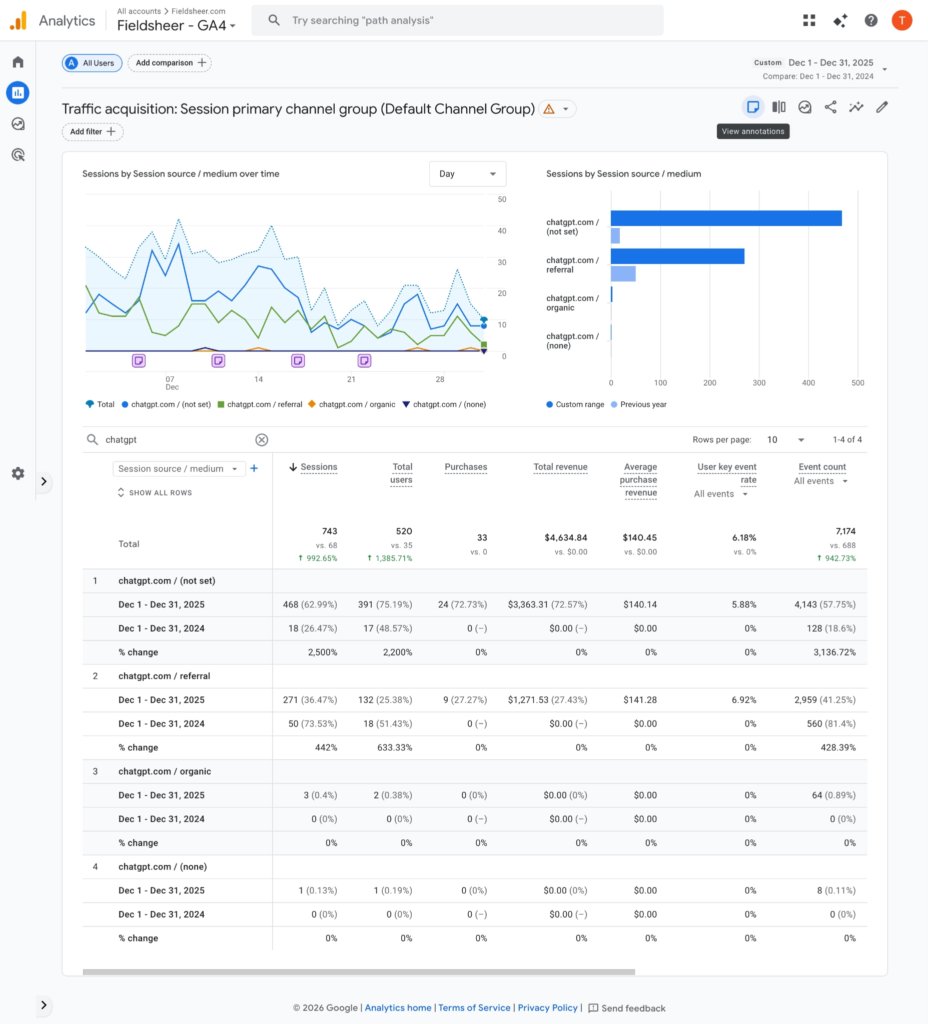
Here is my proof. When we built product listicles for Fieldsheer targeting phrases like “best heated jackets for men,” ChatGPT sessions went from 68 to 743 and revenue from that channel went from $0 to $4,634/mo in 12 months. Another client’s AI sessions jumped from 155 to 582 and revenue from $283 to over $5,200/mo.
The wider market says the same. Adobe’s traffic report shows AI referrals to retail grew 393% year over year in Q1 2026. The rows are still small next to Google, but they buy like bottom-of-funnel traffic because someone already asked their questions in the chat.
Set up a referral segment for chatgpt.com and its cousins so the proof lands in your reports. My walkthrough on tracking AI traffic in GA4 takes about twenty minutes to implement.
7. Skip the Hacks
You do not rank on ChatGPT with a technical trick, and the biggest one being sold right now is schema. Ahrefs tracked 1,885 pages that added schema and found no major citation uplift on any platform: ChatGPT moved 2.2%, which was statistically zero.
Most SEOs will argue with me on that one. But the data says citations follow crawlable pages, liftable answers, list mentions, and freshness, which are the six steps you just read.
Fundamentals in the right order beat every AI visibility hack. Spend your hours where the citations actually come from.
Want ChatGPT Sending You Customers?
Ranking on ChatGPT is the same discipline as ranking on Google with the order shuffled: open the door to the crawler, answer fast, get named on lists, and keep pages fresh. The stores doing this now are building citations their competitors will spend 2027 chasing.
If you want this run for your store, book a call and I’ll check your robots.txt, your Bing index, and your AI referral rows live, then show you which step is costing you customers today. If you would rather have it done for you, that is what my AI search services cover.
